Home » Best Of, IT Asset Management » What Is IT Asset Management?

What Is IT Asset Management?

What is IT Asset Management?

“IT Asset Management is the business practice joining financial, contractual and inventory functions to support life cycle management for IT environments”
Wikipedia

I once heard someone say that money and legislation drive behaviour in the business world.

The same could be said for ITAM. Although I believe ITAM should be more proactive than a spreadsheet of asset costs, it should include managing assets effectively to enable change.

An example of IT Asset Management providing meaningful levers so that a business can make changes can be seen in action here: “Industry Leading ITAM Implementations“.
What-is-IT-Asset-Management

What is IT Asset Management (ITAM)?

The Lynchpin

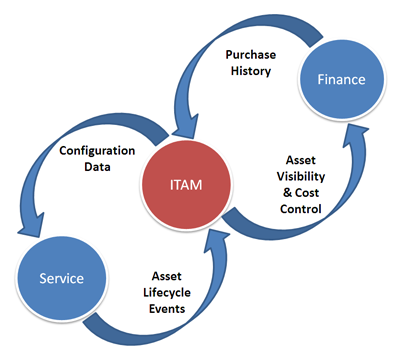
I see ITAM being the lynchpin between the forces of Finance (Money and Compliance) and Service (Change and Improvement).

For me, ITAM represents all the systems, processes, checks and balances to measure and manage IT Assets in an organisation.

The benefits of effectively managing IT assets in a business might include:

  • Visibility and control of IT Assets
  • Improve utilization of assets
  • Compliance with audit requirements
  • Compliance with regulatory requirements
  • Reduce software and hardware costs
  • Support organisational change and projects
  • Align IT Asset Costs to Services
  • Provide configuration data for Service Management

ITAM provides Service with a data source for the assets they are working with so the business can make accurate decisions about serving users and driving change. ITAM provides Finance with a bird’s eye view of an organisations IT balance sheet and compliance commitments.

What do you think? What does ITAM mean to you? what benefits have I missed?

Related Posts with Thumbnails

6 Responses to " What Is IT Asset Management? "

  1. Jay Letendre says:

    I think that in addition to the benifits you’ve listed above, a successful ITAM needs to involve solutions that are simple for the end-user to use and have the client in mind, this a fundamental aspect to a successful implementaion. We cannot forget that people are going to be the ones using the solution IT decides to deploy. Automation is great, however people are still a factor, and if the systems are to complex and complicated they will not be used…..If it is not people-centric and to difficult to use the organization will not see the benefits you’ve listed above.

  2. Ilan Justh says:

    One of the prime results of ITAM implementation is KNOWLEDGE. Not only does it allow you to make smarter decisions in hardware and software usage but perhaps even more importantly it provides the ammunition critical to contract negotiations. If you can tell your vendor that you have only 1000 units in use rather then the 3500 you previously had under maintenance that is a HUGE savings. You can now negotiate for lower prices, more throw in items, freebies, and so many other things. It tells you that modules and versions are not in use, items that are past lease and eligible to be returned, and all the other little gems that ITAM mines.

  3. SUNIL KUMAR, KUMARAN says:

    Martin: You have covered the list quite comprehensively. However, since you have added the Service piece we need to term it as ITSM which will comprise of both Asset & Service Management. As regards the missing piece, i would say that PROCESS is the key item that has been missed. To me the success of ITSM lies in the underlying process. As you are aware these products are ITIL compliant, right out of the box. Hence to ensure that the clients get the best ROI out of these tools, it is important to imbibe best practices & processes. It is vital that prior to implementation a gap assessment is carried out in the process side and proprely addressed. My experience has taught me that however feature rich the product be, if there are no processes governing it, the implementation will not give the desired benefits. I assume you have covered the License Compliance under the audit requirements, else that is another key benefit. Also benefecial is the License Useage and entitlements. Believe me, the complexity increases in a virtualized environment. Change Management is another key piece to go with from an ITIL perspective. To summarize, ITSM provides us with a great platform to implement and manage the processes around Service Request, Incident, Problem, Change Management, Availability & Release Management. The other two features being Service Level Agreement & Service Catalogue. You may also want to include the advantage of integrating the ITSM tools to enterprise applications (ERP, Contracts, HR Systems, Vendor Management, Mobile Devices etc.,). Let me know if you have any questions around this. Sunil Kumar

  4. The BIGGEST opportunity for cost improvement from an effective ITAM is not the process, tools, team players but the business analysis and corresponding architecture. Most SAM groups only look at tracking the assets, validating proper pricing and ensuring that unused assets are not kept on the financial books. People need to make sure the assets are optimized. Did a SAM team do a good job if they purchase 10 license at a good discount? Not if they should have built a data center architecture to get by with 2 licenses. In analyzing over 500 companies, over 60% of potential savings comes from architecture. Unfortunately, that is done in only 1% of SAM teams.

  5. Hi Sunil,

    Thanks for your comments, but I deliberately called it “service” because ITAM or Service does not have to be based on ITIL.

    Martin

  6. [...] What is IT Asset Management? (September 2009) [...]

Leave a comment